Preoperative clinical and magnetic resonance imaging-based predictors of outcomes after arthroscopic discopexy for temporomandibular joint disc displacement

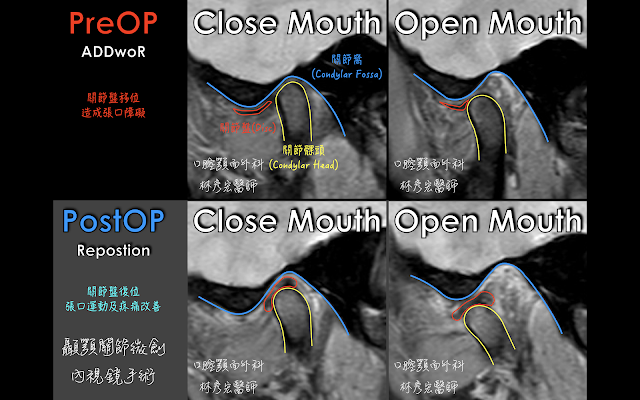
I am delighted to share that our team's latest research on TMJ arthroscopic discopexy has been officially accepted for publication in the prestigious journal, Journal of Cranio-Maxillofacial Surgery. Our study's multivariate analysis indicated age (odds ratio [OR]: 1.041; p =0.010), absence of spontaneous disc reduction (OR: 3.164; p =0.009), and rotational displacement (OR: 1.901; p =0.038) as independent predictors of persistent disc displacement. Postoperative disc elongation was strongly and negatively associated with preoperative disc length (r =− 0.483; p < 0.001) and positively associated with displacement distance (r =0.305; p <0.001).
https://www.sciencedirect.com/science/article/abs/pii/S1010518226000648?via%3Dihub
很高興與大家分享,我們團隊關於顳顎關節微創手術的研究成果,正式被國際知名期刊《Journal of Cranio-Maxillo-Facial Surgery》接受發表!
對於許多飽受顳顎關節疼痛、卡頓、張口受限所苦的病友,微創內視鏡顳顎關節盤復位縫合手術(TMJ Arthroscopic Discopexy) 提供了一個復原快且有效的治療選擇。但醫師與病患最關心的問題往往是:「手術後,位移的關節盤真的能乖乖待在正確的位置嗎?」
我們的研究團隊回顧分析了 193 個接受過 TMJ Arthroscopic Discopexy 案例,並透過術後MRI 驗證,找出了影響手術成效的三大關鍵預測因子,分別是:1. 年齡( 隨著年齡增長,關節組織的修復能力與彈性會有所不同,研究發現每增加一歲,術後關節盤持續位移的風險會微幅增加約 4.1%。)2. 術前關節盤為不可復位性的移位(ADDwoR)(術後復發的風險比可復位患者高出 3.16 倍。)3. 術前關節盤有旋轉性位移(Rotational displacement)(失敗風險會增加 1.9 倍。)
這項研究的發表,不僅是對我們團隊臨床手術技術的肯定,更為未來的術前評估與個人化治療計畫提供了科學實證。建立這些預測模型,能讓我們在術前更精準地與患者溝通預後,並針對高風險的案例制定更完善的術後復健與追蹤策略。由衷感謝所有共同作者與研究團隊成員的付出,我們將繼續努力,為顳顎關節疾病的治療帶來更多突破!